
This is the moment we have been working towards for years. There was an almost palpable tension in the courtroom, as if everyone were holding their breath.The final round in our Climate Case against Shell, and we would like to take you through how the day unfolded.
Early in the morning, we made our way to the Supreme Court together. With a healthy sense of anticipation and, above all, with pride. Because we are standing here, facing one of the world’s biggest polluters, demanding that it makes a fair contribution to combating the climate crisis.
This is the first time a country’s highest court has considered a case of this kind. And the whole world is watching.
When it was time to go inside, the tension mounted further. Our lawyers, colleagues, journalists and coplaintiffs took their seats in the courtroom. The buzz of conversation fell silent as the judges entered.
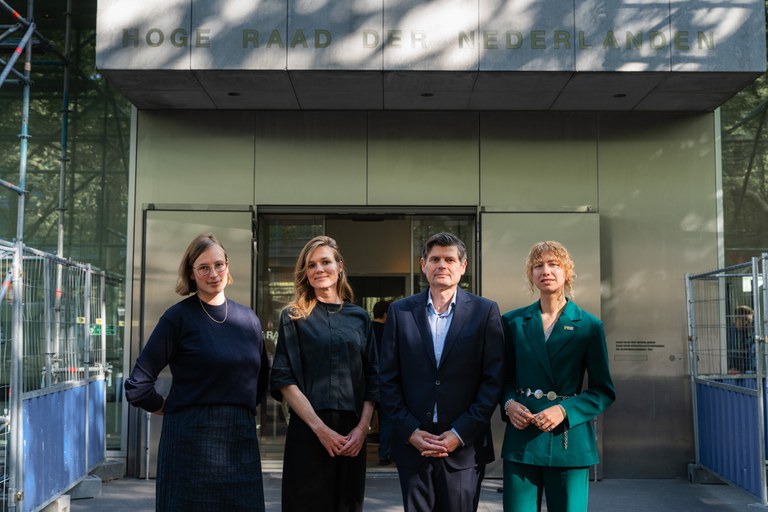
Maria Veder (Research Lead Climate Case Shell), Maaike Baan (Researcher Climate Case Shell), Roger Cox (lawyer) en Winnie Oussoren (spokesperson) in front of the Supreme Court
The hearing began. All parties were given time to present their arguments. This was the moment: our chance to explain to the Supreme Court why it is so important and logical that Shell be given a specific target to reduce its CO₂ emissions. In the court’s ruling on the appeal in 2024, the court had already ruled that Shell must reduce its CO₂ emissions, protect human rights and make a fair contribution to the Paris Climate Agreement. A strong and important ruling, but without a specific target, it remains too open-ended binding. A specific target is needed to truly protect us from the danger to which Shell exposes us.
Our lawyers Roger Cox and Philip Fruytier spoke with calm, clarity and conviction. Shell pulled out all the stops, resorting to its familiar excuses and attempting to deflect responsibility onto politics and consumers. Milieu en Mens, which is participating in the case on Shell’s side, also presented its submissions.
After a short recess, all parties were given one final opportunity to respond to each other’s arguments. And then it was over. The presiding judge closed the hearing. Now it is up to the Supreme Court to rule on this historic case.
Shell continues to insist that reducing its CO₂ emissions in line with the Paris Climate Agreement would jeopardise energy security. But the opposite is true: clinging to fossil fuels is what makes us dependent and vulnerable. Our lawyer Roger Cox' words on this subject:
If Shell were truly concerned about energy security, it would shift its investment flows towards renewable energy, but that is not happening at all. The share of renewable energy in Shell’s total energy production is less than 0.5%.”
In 2024, in the appeal ruling , the court ruled that Shell must reduce its CO₂ emissions, but did not set a specific target because scientists were reportedly unable to agree on an exact percentage for a company like Shell. Our lawyers explained that, in our view, the Court of Appeal had taken too narrow a view: it is not only climate science that counts, but also, for example, principles of international law. Had the judge also taken this into account, a specific reduction target for Shell could indeed have been set. And that is needed, because Shell is one of the world’s biggest polluters.
Everyone listened intently as our lawyer Roger Cox delivered the closing words of our oral arguments:
"If Shell is allowed to continue like this, we must conclude that modern society and the choices made within it have created private-law entities that are more destructive than states, yet which no one can keep in check. Not through politics, nor through the law. In that case, the democratic rule of law and the international legal order will have proved more vulnerable than we thought, and we will collectively have to pay the costs for that. That price will be high, unimaginably high.”
This would never have been possible without the 17.379 coplaintiffs and the 6 coplaintiffs organisations: Greenpeace, de Waddenvereniging, ActionAid Netherlands, BothENDS, Fossielvrij NL and Milieudefensie Jong. We are incredibly proud of how far we have came together! The ruling is yet to come, but today we have demonstrated that we have done everything in our power to convince the highest court that Shell must be held to a concrete target to reduce its CO₂ emissions. And whatever the outcome: this case has already made history.
Time is running out and the world is watching. A liveable future demands action. We cannot wait. we won’t stop until all large polluters deliver on green promises. Large polluters are powerful. But united, we as people have the power to change them.
We can only pursue legal cases like this thanks to your support. Will you contribute so that we can continue our fight against Shell?
—> The final round against Shell: everything you need to know
—> Explainer: why we are appealing to the supreme court
Our website uses cookies to ensure the use and functionality of this website. Read more about our cookie policy
